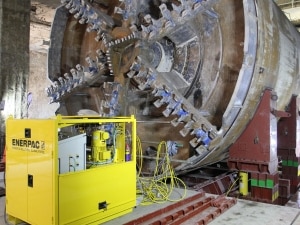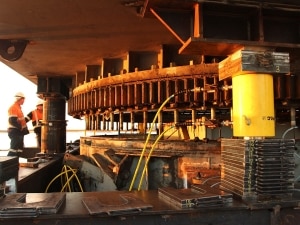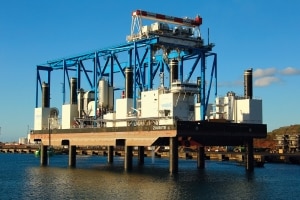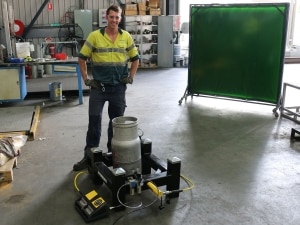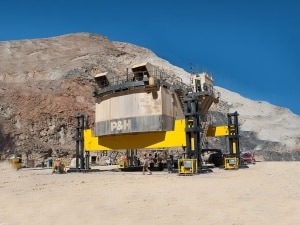
34 Enerpac jacks are positioned horizontally in two floor levels to support the concrete walls and floors Enerpac 500 ton double-acting lock nut jack with positioning sensor and Class A load cells Enerpac power pack and PLC-control unit monitors 34-point synclift system Enerpac synclift monitors foundation movement between church, museum basement and surrounding buildings The Enerpac jacks keep the surrounding buildings in position during construction of the Prado Museum’s extension

Intelligent hydraulics stretch out the Prado museum

Customer: 
ACS
Location: 
Madrid, Spain

Spain’s prestigious Prado Museum in Madrid is expanding its exposition room to 16.000 square meters. In the heart of this magnificent city earth is moved by excavators to construct the museum’s extension. The new exhibition space is partly underground, stretching from the existing Prado buildings to the adjacent 16th century Jerónimo Church. The museum, built in 1819, wants to distinguish itself from two other museums in Madrid the well known Thyssen-Bornemisza Collection and the Reina Sofia Museum of contemporary art exhibiting Pablo Picasso’s famous Guernica.
The Prado Museum is renowned as being the largest art gallery in the world. It also exhibits sculptures, drawings, coins and other works of arts, but it is undoubtedly its large collection of paintings which has given it fame worldwide.

It houses more than 8,600 paintings, of which they exhibit less than 2,000 because of lack of space available. Many museums throughout the world have less artistic riches in their halls than the Prado Museum has in storage.

The Prado extension, a project of 42 million euro started in April 2003. After opening, early 2004, the Prado extension will house a library, a workshop, an auditorium and temporary exhibitions. It is expected that the yearly 1,8 million visitors will increase to 2,5 million.

Extending the exhibition space

In the design of the extension by the Spanish architect José Rafael Moneo, much of the new space is underground on two levels. A tunnel forms the connection between the existing and the new Prado buildings. The 16th century Cloister of Jerónimo has been removed stone by stone and will be re-assembled in the new museum’s extension. Where the cloister stood, excavators dug a pit of 46 x 20 x 20 meters (lxwxh). Such a large hole will make the foundations of the surrounding buildings and roads unstable. A solution was required to support the walls of this pit with the ability of controlling any ground movement. Enerpac Hydraulic Technology was consulted as specialists in integrated hydraulic systems and 700 bar high pressure hydraulics for the solution to control the ground movement.

Controlled movement

In the early stage of the project, at the time the construction procedures and specifications were being defined, ACS one of Spain’s largest construction companies and Enerpac developed a 34 point PLC-controlled movement system. Involving Enerpac at the start of the project means hydraulics and construction experts can work closely together increasing efficiency and adding value to the project.

The Enerpac integrated hydraulic synchronous system measures and monitors any movement of the foundation caused by the load of the surrounding buildings and traffic. In total 34 double-acting lock nut jacks, each with 500 ton lifting capacity and 100 mm stroke (CLRL-5004) are used. Each hydraulic jack is equipped with a positioning sensor to measure movement (plunger travel) and a tilting swivel saddle to compensate for side load caused by non-centered loads. Each group of 17 hydraulic jacks include six Class A 500 ton load cells with an accuracy of 0,1 %.

An Enerpac PLC-controlled synchronized hydraulic system monitors and adjusts any foundation movement between the church, the Prado Museum basement and surrounding buildings during construction.

PLC-Controlled Synchronous Pushing


The new extension underground has two floor levels. During the construction period any foundation movement must be controlled using hydraulic jacks. On each floor level 17 hydraulic jacks are positioned horizontally between the supporting walls and the concrete floors. The concrete floors are not yet fixed into the surrounding basement walls but have a floating construction. This is needed to accommodate and measure any foundation movement during the construction works. All 34 jacks push and keep the walls in their position so the new extension can be built without the danger of the basements’ walls collapsing. 

PLC-Remote Control
The hydraulic system with 34 jacks can be synchronized on plunger stroke or load and is controlled by a PLC-remote control unit with touch screen panel. The real time display of the PLC-control shows the total plunger stroke, relative plunger stroke and total load of each jack individually. The screen displays the first and second floor level readouts of each group of 17 hydraulic jacks. Alarms signal when the plunger stroke or load on a jack reaches an unsafe level.

All hydraulic jacks are powered by one large two stage electric pump connected with about 2000 meters of hydraulic hoses. The PLC control unit includes an emergency stop and extra system safety features to signal voltage and power consumption, pump overload, oil level and temperature

Hydraulic System Integration

In the use of hydraulics in heavy construction projects, application knowledge and expertise are very important. Accurate lifting, lowering or pushing have a significant effect on structures. Very accurate manual control and monitoring is complex and very time consuming. And more – accuracy is more important than speed – the advantage of PLC controlled integrated hydraulic systems is enormous. Every step of the lifting process can be monitored via the display of the PLC control unit. Apart from the very accurate and stress-free movement of concrete segments, structures, etc. Enerpac provides a safe, easy to manage, cost- and laborsaving solution.