Strand Jacking System Hoists L-o-n-g Concrete Beams into Place
Faced with the challenge of placing precast concrete girders more than 200 feet long across a 200 foot-deep gorge, general contractor Hawaiian Dredging Construction Company, Inc. turned to a strand jacking system. The novel technique was employed in construction of the new Kealakaha Stream bridge, a part of Hawaii Route 19.
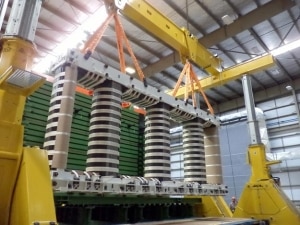
“This is the first time in Hawaii that concrete girders are being used for such a long span,” says Hawaiian Dredging project superintendent Glenn Koki. “There are six girders, each about 210 feet long and weighing 135 tons,” he explains. According to Koki, the girders were precast in Washington state in nominal 50-foot sections and brought by ship to Hawaii. On-site, the delivered 50-foot girder sections (shown below prior to splicing) were positioned on combination fabrication-and-launch tables where they were spliced and tensioned to form the final 210-foot long girders. Working support across the gorge was provided by a prefabricated truss bridge from Acrow Corporation of America. Widely used for both permanent and temporary bridges, the Acrow design is a descendant of the Bailey bridges that played a major role in moving Allied forces during World War II.
As a practical matter, the Acrow bridge was narrow and repositioned for each girder launch. With the Acrow bridge in place for a given girder, “The girder would be winched onto the bridge, lifted by means of the strand jacks at each end, the temporary bridge removed, and the girder lowered into place,” explains Koki. Each strand jack carried a 156-metric ton rating and had its own 11 kW power unit.
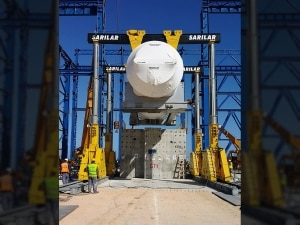
In order to utilize the strand jacks, lifting towers were erected at each end-point of the girder to be placed (see below). As with the truss bridge, the width of the lifting towers was just sufficient for placing one girder, and then the towers were moved to the next placing position (top of next page). Prior to actual lifting, the Hawaiian Dredging crew trained with a strand jack on a miniature version of a lifting tower (sidebar).
How the lifting system works
The jacks provided by Enerpac Integrated Solutions operate by grabbing and lifting or lowering cables passing through their hollow centers (see illustrations below). Note that Cable lock devices are shown in red when closed, blue when open.
Lifting
Lifting: Left to right, (1) Bottom wedges close, load is held stationary, top wedges open. (2) Top wedges close, bottom wedges open. (3) Cylinder extends, load is raised. (4) Bottom wedges close, load is held stationary, top wedges open. (5) Load is held stationary, cylinder retracts.
Lowering
Lowering: Left to right, (1) Top wedges close, bottom wedges open. (2) Cylinder retracts, load is lowered. (3) Bottom wedges close, load is held stationary, top wedges open. (4) Load is held stationary, cylinder extends.
According to Koki, on-site assistance from Enerpac “was key” to a successful operation. The girders have all been set, and work is expected to be completed by the end of 2009.
<<<
Project facts
The new 750-foot Kealakaha Stream bridge will replace an existing bridge constructed in 1934. The existing bridge does not meet modern seismic standards (especially important in this seismic-active area), it is relatively narrow, and its curve creates visibility problems for drivers.
The new bridge is part of Hawaii Route 19, which is the main artery between the cities of Hilo and Kona on the largest island of Hawaii.
<<<
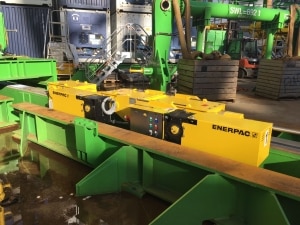
Practice makes perfect
Practice makes perfect. After receiving training from jack manufacturer Enerpac Integrated Solutions, the Hawaiian Dredging crew used the practice setup shown below to become thoroughly familiar with the equipment. The strand jack is the yellow unit at the top.