4-points synchronous stage lifting system lifts and lowers the wooden bridge 4-points synchronous stage lifting system lifts and lowers the wooden bridge After assembly, the bridge was lifted to the correct height for its final position, using Enerpac’s computer-controlled hydraulic Synchronous Lift System Akkerwinde wooden bridge Akkerwinde wooden bridge Assembly of Akkerwinde wooden bridge Assembly of Akkerwinde wooden bridge Assembly of Akkerwinde wooden bridge Bridge facts: steel deck and two vertical, wooden arches, 32 m long, 16 m high. Enerpac digital and synchronous hydraulic lifting technology and stage lift systems - the solution for bridging longer distances and controlled hydraulic movements. First wooden bridge in the world in this size and for all kinds of traffic Lifting and lowering the 360 ton wooden Akkerwinde bridge PLC-control unit with touch screen The Akkerwinde bridge is made so unique by the fact that the wooden construction is able to support the steel deck

Synchronous stage lifting of a 360 ton wooden bridge

Customer: 
Wagenborg Nedlift
Location: 
Sneek, The Netherlands

At the end of November 2008, a 360 ton wooden bridge was positioned over the A7 national trunk road near Akkerwinde in Sneek (the Netherlands), completing the first phase of a unique project. Prior to being transported with SMTPs from the nearby assembly site to its destination, the whole bridge construction was lifted to a height of more than five metres using Enerpac’s hydraulic computer-controlled Synchronous Lift System.
The “Rijksweg 7 Sneek” project was commissioned by the Province of Friesland, Rijkswaterstaat Noord Nederland (Ministry of Waterways and Public Works for the northern Netherlands) and the Municipality of Sneek. The project consists of building two wooden bridges over the new southern A7 ring road. Both bridges – which are actually viaducts – form “landmarks” or recognisable features of the town. As part of the first phase, a new bridge was placed in the Akkerwinde location at the end of November. The second bridge is planned for the Molenkrite area. Where and in what capacity the second connection will be built and positioned depends on experiences with the newly positioned bridge in Akkerwinde.

Accoya®
The new bridge consists of a steel deck and two vertical, wooden arches that are 32 metres long and 16 metres high. Bolts and legs join the arches together. The bridge was designed by OAK architecten - a collaboration between the engineering company Ingenieursbureau Oranjewoud in Heerenveen, Achterbosch Architectuur in Leeuwarden and Onix in Groningen. The wooden arches were built by contractor Schaffitzel from Schwäbisch Hall in Germany. Wagenborg Nedlift from Groningen was responsible for assembly, lifting, transport and positioning.
The bridges are an example of progressive architecture, of which the term “durability” is an important element, alongside aesthetic and structural criteria. This applies to both the materials used and the lifespan.

What makes the bridge unique is the wooden arches and its use. Whilst there are already a few modern wooden bridges in the world, none of them until now have been built to such a scale and to support all traffic.
Laminated cribbing blocks made of Accoya® wood measuring 1080 x 1400 mm were used for the arches. This type of wood comes from production forests in New Zealand and is produced and supplied by the Dutch company Titan Wood. Following the process of acetylation, the wood naturally absorbs less moisture, therefore increasing its durability. The German manufacturer Schaffitzel guarantees a lifespan of 80 years for this wood, as long as it is properly maintained.

Digital lifting
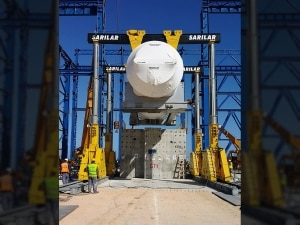
The new bridge's deck and arches were mounted on an assembly site around one and a half kilometres away from the bridge's current location over the A7. After assembly, the bridge was lifted to the correct height for its final position, using Enerpac’s hydraulic computer-controlled Synchronous Lift System, which Wagenborg Nedlift invested in some time ago.
Project leader Michel de Jong of Wagenborg Nedlift is extremely pleased with the operation's progress and with the lift system in particular. “The system works perfectly. We have already used it a number of times, but what was unique about this project was that we had to lift the bottom of the bridge up to 5.10 metres, whereas the lift system’s highest prop was 4.40 metres.”

Four abutments
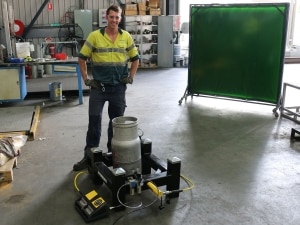
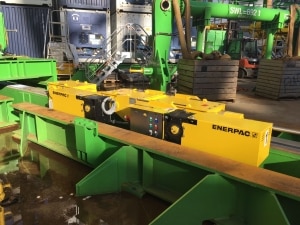
The Enerpac Synchronous Lift System is a combination of digital control, switching and monitoring. Thanks to specific software, lifting (and lowering) is extremely accurate; the lift system can lift even the heaviest loads with a controlled accuracy of 1mm.
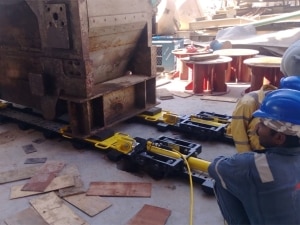
Only four abutments with BLS Stage-Lift double-acting cylinders (one under each corner of the bridge) were needed to lift up the special massive bridge. The BLS cylinders are intended for the “Lift and Crib” system and have integrated supports to make it easier to position underlying padding materials.
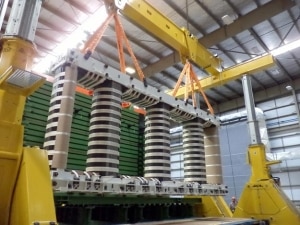
The four lift cylinders, with a total capacity of 1000 tonnes, were placed on hardwood outer cribbing blocks, which were stacked diagonally layer for layer. A new layer of outer cribbing blocks was put down after around each 10cm of lifting. In this way, the bridge was lifted around 50 centimetres per hour and in the end, the whole construction rested on four "cribbing block towers", each approx. four metres high.
Each cylinder was connected to its own hydraulic pump unit, which was controlled by computer using sensors placed right next to the lift cylinders.
The computer program controlled the cylinder movements, independently of the measurements, by switching the hydraulic directional control valves.
 During this control, short impulses are sent to the valves in fractions of a second, so that individual cylinder movements are kept much smaller than is possible using manual control.

Not only does the Wagenborg Nedlift system save a considerable amount of time compared to manual lifting, but it also has a very essential advantage: thanks to the synchronous and therefore perfectly balanced lifting, virtually no internal stresses arise within the load. Michel de Jong: “We chose Enerpac because it is a company that operates internationally, but more importantly because of the accuracy of its system. The Synchronous Lift System allows us to perfectly manage and monitor the whole operation. And the data saved can be considered afterwards, together with the customer, to evaluate how things went. And with this project, everything went as we wanted it to.”

Wooden bridge facts and figures
The Akkerwinde bridge is made so unique by the fact that the wooden construction is able to support the steel deck. Furthermore, traffic from the highest traffic class (60 tonnes) can drive over it. A list of wooden bridge facts:
Length: 32 metres
Width: 12 metres
Height: 16 metres (not including the substructure)
Total weight of the wooden superstructure and steel substructure: 360.000 kilo
Weight of drive bolts and link-up bars: 9000 kilo
Quantity of wood: 690 cubic metres
Type of wood: Accoya®

Accoya® wood
Accoya® is a modified type of wood through and through. In order to guarantee a long lifespan, the wood is preserved following a new procedure: acetylation. Acetylation is the process of modifying wood using acetic anhydride. The procedure changes the cell structure, meaning the wood’s properties are comparable with or even better than those of tropical hardwood. The Titan Wood factory in Arnhem, where this new method of preservation is carried out, has only been in production since January 2008. This modification has two important advantages: When sawing or profiling Accoya® wood, wooden surfaces that have not undergone acetylation can never be exposed. This means it is not necessary to protect such surfaces with environmentally unfriendly substances, as is necessary for the "envelope treatments".