Hydraulics Help Gallatin Steel Move Ladle and Meet Shutdown Timetable
The technologically advanced Gallatin Steel Compact Strip Production Facility in Ghent, KY has been in operation since 1995. The plant is relatively young, but mature enough to schedule maintenance shutdowns.A maintenance shutdown at any plant is likely to be both carefully orchestrated and highly stressful as multiple trades dance around each other.
An eight-day maintenance shutdown in October 2006 included a particularly critical operation:overhaul of the thin slab caster ladle turret slewing bearing. Fortunately, a novel approach using synchronized hydraulic jacks freed up the mill’s shop cranes for other necessary tasks. (The turret is located between two overhead crane bays. Although it could have been lifted using the two cranes with a cross-beam, that would have tied up both cranes.)
Plant overview
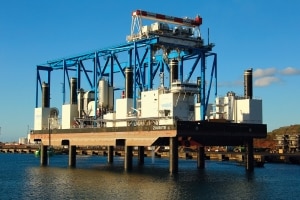
The plant converts scrap steel to new hot-rolled steel coils.Scrap is melted in a twin shell electric arc furnace, then passes through a ladle metallurgy facility where adjustments are made to the batch composition as needed. The ladle then moves to the caster and is positioned on a rotating turret. The caster produces slabs, which travel through a 675-foot long tunnel furnace to a six-stand rolling mill, then to a coiler.
Role of hydraulics
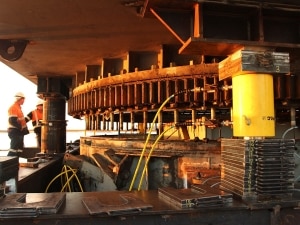
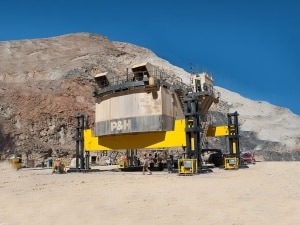
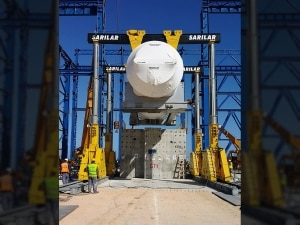
Dick Kelly of R.G. Kelly Inc. designed equipment and wrote a procedure for disassembly of the ladle turret.The approach utilized synchronized hydraulic jacks to lift the upper turret section off its bearing for placement onto a custom-fabricated transfer car, which then moved it 23 feet on a specially fabricated runway. Three D Metal Works did the fabrication and provided project management and turnkey services for the project.
The transfer assembly was fabricated at the Three D facility, where all aspects were tested for proper operation.No one wanted any surprises on this job.
The transfer car incorporated eight 100-ton Enerpac jacks, four on each side, mounted upside-down.Hydraulic plumbing and load position sensors were integrated into the car at each jack position. The jacks chosen were double-acting, 100-ton cylinders with 12-inch stroke. The 800 ton lifting capacity provided ample margin for the lift weight of approximately 300 tons.
The Digital Advantage
The lifting could have been accomplished in a traditional manner, using manually controlled jacks, but that’s more easily said than done.Manually raising each of the eight lift points in precisely equal increments is tricky and extremely time-consuming. Too great a variance in the lifting at various points would tilt the turret and cause it to bind on the 17-inch long mounting bolts. And, unequal lifting can induce internal stresses in the object being lifted.
The word “digital” may bring to mind complicated, difficult-to-operate equipment, but Enerpac’s award-winning Synchronous Lifting System is elegant in its simplicity for the user.]The Sync-Lift operating system receives electronic signals from position sensors that are attached to the load close to each lifting cylinder. These signals are processed, and based on the results the computer switches hydraulic control valves on and off.
Accurate load position measurement at each lift point is crucial.A non-uniform load exerts different forces at different lifting points. Furthermore, as jacking commences and the load rises, the base of a cylinder may drop slightly as its underpinning compresses. The Sync-Lift position sensors utilize a thin cable that unwinds from a spool. The end of the cable is attached to the load and the sensor is attached to a stable reference surface (or vice-versa). The result is simultaneous load position monitoring accurate to +/-0.04 in. at each jack.
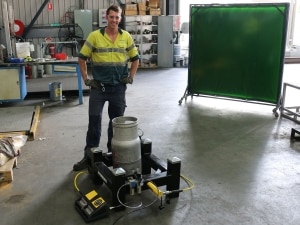
The hydraulic pump and digital controller were installed in a gang box for protection, and the manifold/gauge assembly was mounted in another gang box.In addition to monitoring load position for each of the eight cylinders, the digital controller offers considerable flexibility in programming the lift.
Moving the ladle turret
The upper section of the turret had to be moved in order to gain access for two milling machines to simultaneously machine the bearing.The first step in doing the move was to assemble the transfer car under the turret. Under each of the eight 100-ton jacks was a 100-ton roller set .
After nuts had been removed from the 90 bolts (M39-4 x 17-inch) ringing the approximately 15-foot diameter bearing, the lift began with quarter-inch increments.The increments were then increased to half-inch, and next to three quarter-inch. At each increment, shims were inserted at the jack locations and tack-welded in place.
After about 40 minutes the desired lift height of 10 inches was attained, and the turret was moved from above its bearing.The triple roller bearing was replaced, and inspection of the bearing mounting flanges revealed that they still met spec and did not need milling.
The bearing work was completed and the turret set back in place within 24 hours.A critical aspect of the lowering operation was to avoid damage to the new bolts. Even though dowel pins provided side-to-side positioning, it was critical to avoid canting the turret as it was lowered. The Enerpac Sync-Lift System enabled precise lowering of the assembly to avoid damaging the bolts.
By the time all details had been completed six days had passed, one day ahead of schedule.(A 12-hour power outage in the middle of all this didn’t help! Generators and light towers came to the rescue.)
Aside from providing accuracy and control, the Enerpac system helped in finishing the job ahead of schedule.